

If you spend any time in group chats, YouTube comments, or on social media, you have almost certainly seen the three letters NGL.
So, what does NGL meaning? NGL stands for “not gonna lie.” It is one of the most popular pieces of internet slang today, used by teens, young adults, and English learners all over the world.
This guide explains the NGL meaning, where the phrase came from, how to use it in a sentence, how it compares to similar slang like TBH, and when you should avoid it completely.
👉Read More: Slaying meaning in instagram
What Does NGL Meaning Texting?
In texting, NGL is a short slang abbreviation for “not gonna lie.” People type it before an honest statement, an opinion, or a confession.
It works like “to be honest” or “I’ll be real with you.” The goal is to signal that what comes next is sincere, even if it is a little awkward, embarrassing, or critical.
For example, if a friend texts, “NGL, that movie was way better than I expected,” they are telling you their genuine reaction. They are not being sarcastic. They are simply being open about how they feel.
NGL can be written in capital letters (NGL), in lowercase (ngl), or even spoken aloud as “N-G-L” in casual conversation. All three forms mean exactly the same thing.
👉Read More: BW Meaning Text
NGL Stands for “Not Gonna Lie”: Breaking It Down
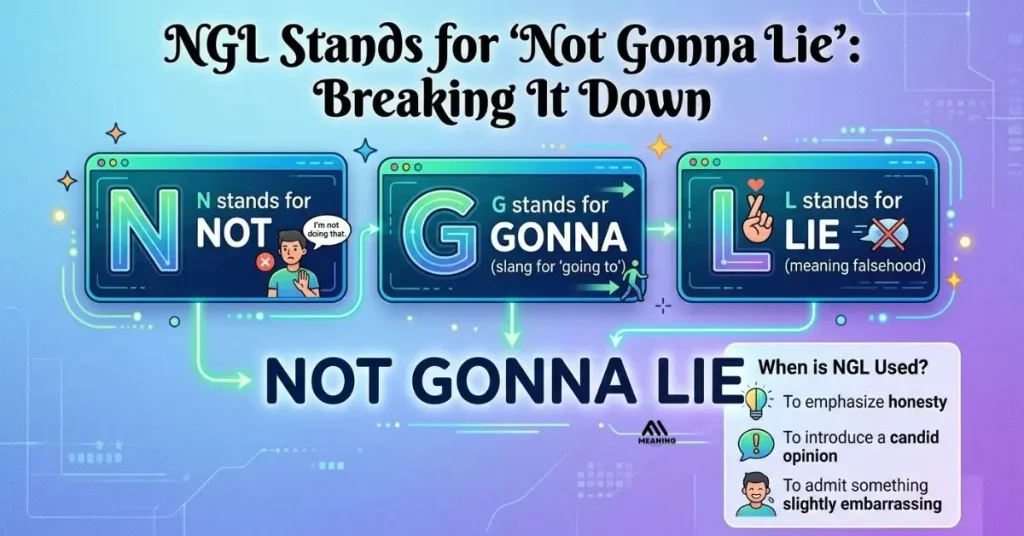
The phrase “not gonna lie” is a casual spoken version of “I am not going to lie.” Native speakers shorten “going to” into “gonna” all the time in everyday speech.
When that spoken phrase moved into text messages and comments, people shortened it again to three letters.
👉Read More: RLS Meaning in Text
The shortened form does three jobs at once:
- It signals honesty. The reader knows a frank opinion is coming.
- It softens the message. Placing NGL in front of criticism makes it feel less harsh.
- It saves time. Three letters are faster to type than three words, which matters in fast chats.
Origin of NGL: Where Did the Slang Come From?
The full phrase “not gonna lie” has been used in spoken English for a long time. The abbreviation NGL, however, grew out of early internet and texting culture.
Some sources point to 2009, when the term was added to Urban Dictionary, as one of the first public records of it. From there, it spread through chat rooms, text messages, and later social platforms.
NGL became especially popular among Gen Z. Younger users on social media adopted it as a quick way to share an opinion without sounding too blunt.
Over time, it moved from teen slang into general internet slang, and today people of many ages understand it.
👉Read More: What Does BBN Mean
Dictionaries such as Merriam-Webster and Cambridge Dictionary regularly track new slang and abbreviations as they enter everyday use, which shows how mainstream this kind of vocabulary has become.
How to Use NGL in a Sentence
The best way to understand NGL is to see it in action. People usually place it at the start of a sentence, but it can also appear at the end. Here are the most common ways to use it, with an example text for each.
1. Admitting something
NGL is very common when someone confesses something a little embarrassing.
- “NGL, I didn’t study for the science test at all.”
- “NGL, I fell asleep halfway through the movie.”
👉Read More: P Meaning in Text
2. Expressing criticism gently
Because it softens the message, NGL helps when you want to be honest without sounding rude.
- “NGL, the ending felt a bit rushed.”
- “NGL, that outfit isn’t my favorite, but the shoes are great.”
👉Read More: what do idm mean
3. Sharing an opinion
People also use NGL for ordinary opinions about books, music, food, and shows.
- “NGL, I didn’t love the new book she wrote.”
- “NGL, this restaurant is better than I thought it would be.”
👉Read More: What Do FW Mean in Text
4. Making a complaint sound less harsh
- “NGL, I was really upset about what happened.”
- “NGL, I’m a little tired of waiting for a reply.”
5. Emphasizing sincerity or giving a compliment
NGL is not only for negative statements. It also adds weight to a compliment.
- “NGL, you should start a bakery. Your cakes are amazing.”
- “NGL, that was the best presentation I’ve seen this year.”
👉Read More: What Does UT Mean in Text
6. Using NGL at the end of a sentence
Sometimes NGL comes last, almost like an afterthought.
- “That song is kind of boring, ngl.”
- “I’m really nervous about tomorrow, ngl.”
Notice that in every example, the tone is casual and conversational. That is the natural home of this slang.
👉Read More: What Does OMI Mean
NGL vs TBH: What Is the Difference?

Many people ask about the difference between NGL and TBH. TBH stands for “to be honest,” and it is very close in meaning. In most situations, you can swap one for the other without changing the message.
👉Read More: KMSL Meaning
| Slang | Stands for | Typical feel | Example |
|---|---|---|---|
| NGL | not gonna lie | Slightly more casual, often a confession or soft criticism | “NGL, I cried at the end.” |
| TBH | to be honest | Frank opinion, often mild criticism | “TBH, I never finished the book.” |
The small difference is mostly about tone. NGL often sounds a bit more personal and conversational, as if you are sharing a secret.
👉Read More: What Does HMY Mean
TBH can sound a little more neutral and direct. Both are informal, and both are extremely common in texts, comments, and captions.
NGL rarely appears alone. It sits inside a large family of texting slang and slang abbreviations. Learning the related terms helps you understand real conversations much faster.
Reactions and feelings: FR (for real), FRFR (for real for real), IKR (I know, right?), SMH (shaking my head), LMAO, LOL, OMG, ISTG (I swear to God), and deadass (dead serious).
Opinions and takes: IMO and IMHO (in my opinion), IDK (I don’t know), IDC (I don’t care), NVM (never mind), TL;DR (too long; didn’t read), hot take, W and L (win and loss), mid (average), slaps (excellent), and hits different (feels uniquely good).
Logistics and replies: BRB (be right back), GTG (got to go), TTYL (talk to you later), OMW (on my way), WYD (what are you doing), HMU (hit me up), DM (direct message), LMK (let me know), TBA and TBD, and ETA.
👉Read More: bb meaning
Internet and social culture: GOAT (greatest of all time), FOMO (fear of missing out), lowkey, highkey, ratio, NPC, rizz, cap and no cap, sus, and based.
A quick example of two of these working together: “NGL, that burger was the best in town, no cap.” Here, “no cap” means “no lie,” so the sentence doubles down on honesty.
👉Read More: lrc meaning
Understanding Register: When to Use Slang and When Not To
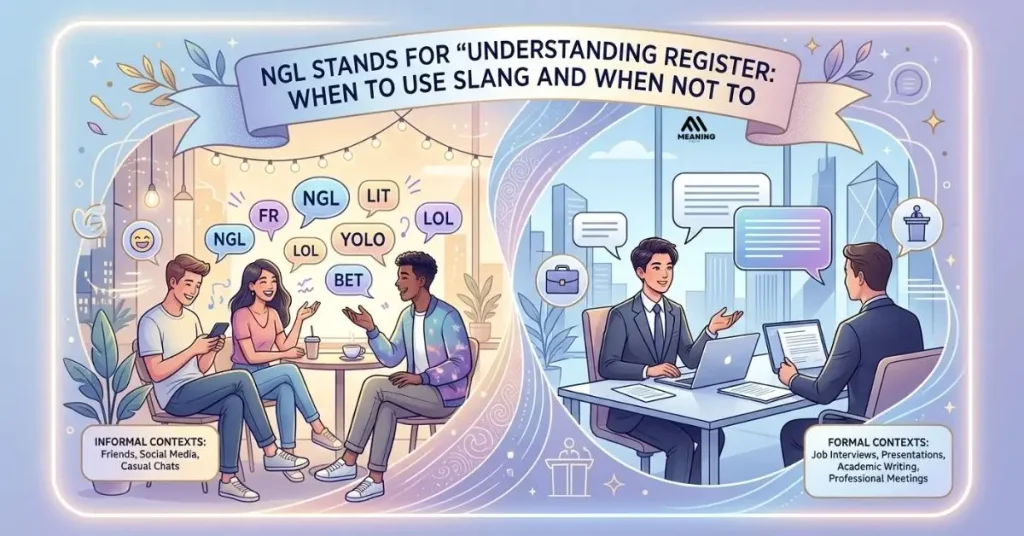
In English, “register” means how formal or informal your language is. Texting slang like NGL sits at the very casual end of the scale.
This is useful to know, because using slang in the wrong place can create a bad impression.
👉Read More: myt meaning
Where NGL is perfectly fine
- Text messages and group chats with friends
- Social media posts, captions, and replies
- YouTube comments and live chat
- Gaming voice chat and online communities
- Direct messages (DMs) with people you know well
In these places, using NGL makes you sound current, relaxed, and natural.
👉Read More: what does tbh mean
Where you should avoid NGL
- Formal emails to teachers, managers, or clients
- Job applications and cover letters
- Academic essays, reports, and exams
- Official or professional documents
In formal writing, “NGL” can look careless. When you are unsure, write the full sentence in standard English, such as “To be honest” or “Frankly,” and save the slang for casual chats.
👉Read More: what does imu mean on snapchat
Is It Okay for English Learners to Use Slang?
Yes, with a little care. If you are learning English, slang can feel confusing because textbooks mostly teach careful, formal language.
👉Read More: what does imo mean in text
Then you open the comments under a popular video and see a flood of short, fast abbreviations that were never in your grammar book.
The main goal for learners should be understanding slang first. Once you recognize terms like NGL, TBH, and FR, you can follow real conversations much more easily.
Using them yourself is optional, and it is best done in casual situations with friends, on social media, and in gaming.
Here are some practical tips for learning modern English slang:
👉Read More: What Does OOTD Mean in Text
- Learn from real content. Watch unscripted YouTube videos, vlogs, and read the comments to see how people actually write and speak.
- Learn in context, not from lists. A word list helps, but a phrase stays in your memory much longer when you see it inside a real sentence.
- Check a living reference. Slang changes quickly. Terms such as “based” or “no cap” can shift in meaning, so confirm new words in a reliable dictionary.
- Notice the tone. Ask yourself whether the speaker is joking, being sincere, or being sarcastic.
- Practice in safe spaces. Try a few terms in chats with friends before using them widely.
👉Read More: what does mw cmean in text
This approach works for idioms too. Figurative phrases and slang both make sense only when you see how people use them in real life.
What About the NGL App?

If you search for “NGL,” you may also find something different: the NGL app. This is not the same as the slang, although the name comes from it.
👉Read More: gdm meaning twitter
The NGL app launched in 2021 and was designed for older teens, aged 17 and above. It lets users play anonymous question-and-answer games such as “ask me anything,” “never have I ever,” “confessions,” and “3 words.”
As the name suggests, the idea is to be honest and give truthful answers, even when they are blunt.
Is the NGL app safe for teens?
The app is more complicated than the lighthearted slang. Because users send answers anonymously, there is a real risk of unkind messages.
Even though the app filters some hurtful content, anonymous messaging can contribute to cyberbullying and low self-esteem. For this reason, parental guidance is a good idea.
👉Read More: what does bgg mean in text
Parents can take a few simple steps:
- Talk openly with teens about what anonymous apps are and why they can be risky.
- Remind them that hurtful messages say more about the sender than about them.
- Encourage them to block and report harmful accounts.
- Check age requirements and privacy settings together.
To keep things clear: when someone texts “NGL” in a normal chat, they are simply using slang. When they mention “the NGL app,” they mean the anonymous Q&A platform.
What Does NGL Mean From a Girl or a Guy?
People often search for what NGL means “from a girl” or “from a guy.” The good news is that the meaning does not change based on gender.
NGL always means “not gonna lie.” What changes the feeling is the context: who is talking, what the relationship is, and what comes after the phrase.
For example, “NGL, I like your style” from a friend is a friendly compliment. “NGL, I was hoping you’d text me” in a different situation may suggest interest. Always read the whole message and the situation, not only the abbreviation.
Final Thoughts
NGL, which stands for “not gonna lie,” is a small but powerful piece of modern internet slang.
It lets people share honest opinions, admit embarrassing things, and deliver mild criticism without sounding too harsh. You will see it in texts, captions, DMs, and YouTube comments every day, and now you can understand it instantly.
Remember the key points: NGL means “not gonna lie,” it is very close to TBH, it belongs in casual conversation rather than formal writing, and it should not be confused with the NGL anonymous messaging app.
If you are an English learner, focus on understanding slang in real context, and you will find that this kind of vocabulary becomes natural very quickly.
FAQs
Where can I learn modern English slang?
The best sources are real, current content: YouTube videos, vlogs, comment sections, group chats, and social media. Watching with subtitles and looking up unfamiliar words as you go is one of the fastest ways to improve.
Is the NGL app the same as the slang?
No. The NGL app is an anonymous Q&A platform for older teens. The slang is simply an abbreviation used in everyday chats.
Can I use NGL in a formal email?
No. Avoid NGL in formal emails, essays, job applications, and exams. Use standard phrases like “to be honest” or “frankly” instead.
Is NGL rude?
No. NGL is usually used to soften honesty, not to be rude. However, the sentence after NGL can still be harsh, so choose your words carefully.
What does no cap mean?
“No cap” means “no lie” or “I’m being completely honest.” “Cap” by itself means a lie.

Hi, I’m M Ahmad Ansari, the founder and content creator at MeaningFolio. With over 3 years of experience in content research and writing, I specialize in explaining word meanings, texting slang, abbreviations, and everyday expressions. My goal is to make language simple and easy to understand by providing clear, helpful, and informative content for every reader.
1 thought on “NGL Meaning in Text: 7 Powerful Secrets You Should Know!”